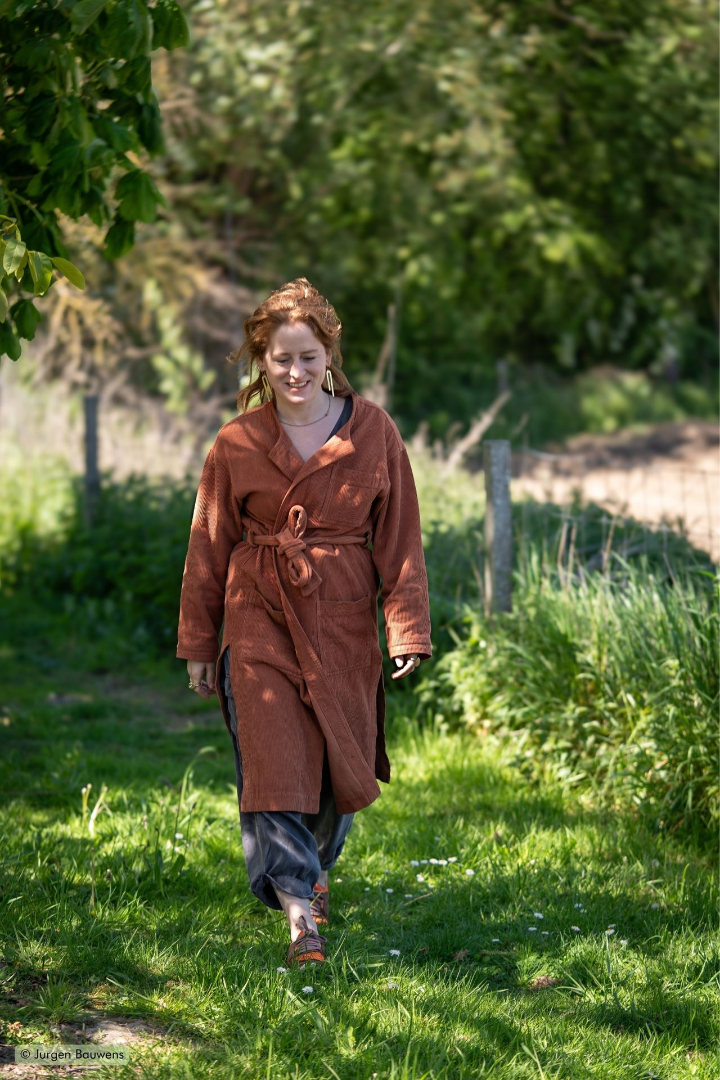
For the Year of the Volunteer, we want to put some of our driven volunteers in the spotlight. In these 'Meet the coach' interviews, we talk with Exchange coaches about their life and work, their experiences in Africa and their take on volunteering. Meet Liesbeth Verhelst, creative, leatherworker and longtime coach of Rwanda Clothing.
Liesbeth & Exchange
Who is Liesbeth Verhelst?
Liesbeth: I have been a leatherworker for twenty years, last year I turned forty. I started much earlier, at about thirteen, making clothes in response to growing up as an identical twin. Until we were twelve, my sister and I were dressed identically; at thirteen we were allowed to choose for ourselves, and because we were constantly perceived as ‘one person’, I wanted to create my own identity by designing my own clothes. At sixteen, I started selling clothes and took evening classes in cutting and sewing, still during my secondary school.
My parents saw no future for me in fashion and pushed me towards a ‘more serious’ diploma: orthopedagogy. During that study, I went on Erasmus to Spain for half a year - my first foreign experience - and that wanderlust turned out to be decisive for my entire further path. After my diploma, I worked for two years in the field, but I had a burnout: as a very sensitive person, I found it hard to work with people, especially vulnerable young people. At that time, I was supporting six young people, two of whom made a suicide attempt during my guidance; I now look back on it with the realisation that it was actually unethical to have a twenty-one-year-old take on such vulnerable support. That experience made me realise that I preferred to work with products, where the result purely depends on myself.
I then studied fashion technology, went to Denmark for half a year, and then developed my own handbag brand, with four years of production in Spain. Travelling and seizing the opportunity to move abroad time and again is a common thread in my life - without that wanderlust, I would never have come into contact with Exchange.
If I had to describe myself, I would say: extremely eager to learn, with a pronounced passion for my craft rather than a ‘career’. Someone who does not live from a fixed plan, but mainly from what comes my way; in terms of living, career, and also the projects I take on for Exchange.
What do you do professionally?
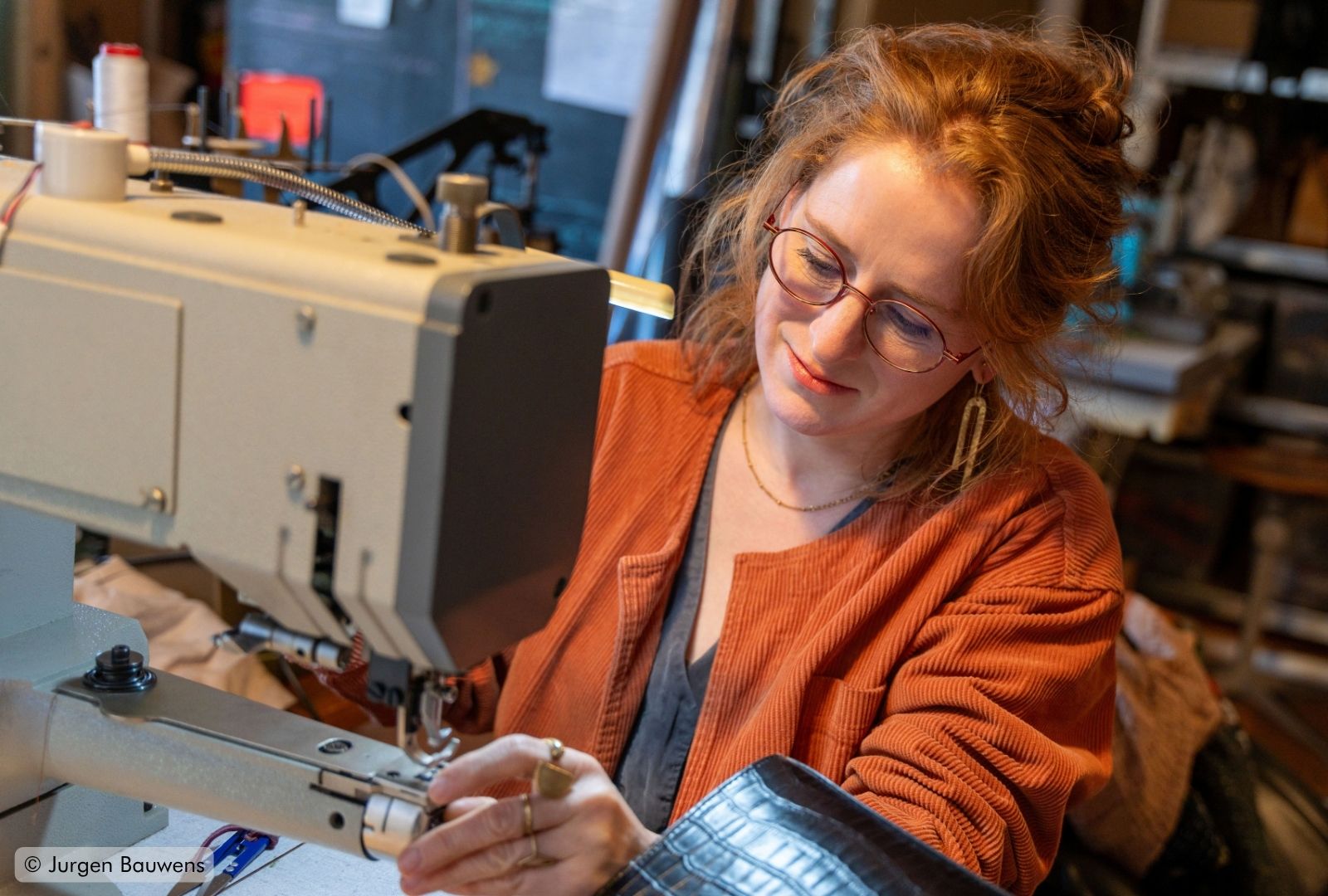
Liesbeth: I run a repair workshop for leather goods, where I also repair high-end handbags. Very technical, especially in terms of construction. In addition, I give workshops where I teach people how to repair leather goods themselves, to bring a repair culture closer and encourage less waste. I also develop custom products for others. For example, I designed a tool pouch for the frame of a Belgian electric bike, and Kantha jackets for Solid Crafts, which has workshops in Kenya, India, and Peru. I also worked as a ghost designer for a handbag brand that processes leather from locally slaughtered cows.
I also teach at various schools and am currently in a phase of strong growth. In my workshop, I work closely with my colleague Justine: I specialise in construction repairs, while Justine focuses on colour restoration.
How did you end up at Exchange?
Liesbeth: I got involved more or less by chance. My beautician had a friend who was asked by Exchange to go to Senegal, but that friend wasn't interested in the assignment because she was in fashion herself and it was about leatherwork. That's how the question came to me. I said yes immediately - I have always been interested in what happens outside Belgium - although I was completely unprepared for what awaited me. Exchange was also functioning in a very different way at that time.
What does your role as a volunteer coach for Exchange actually involve?
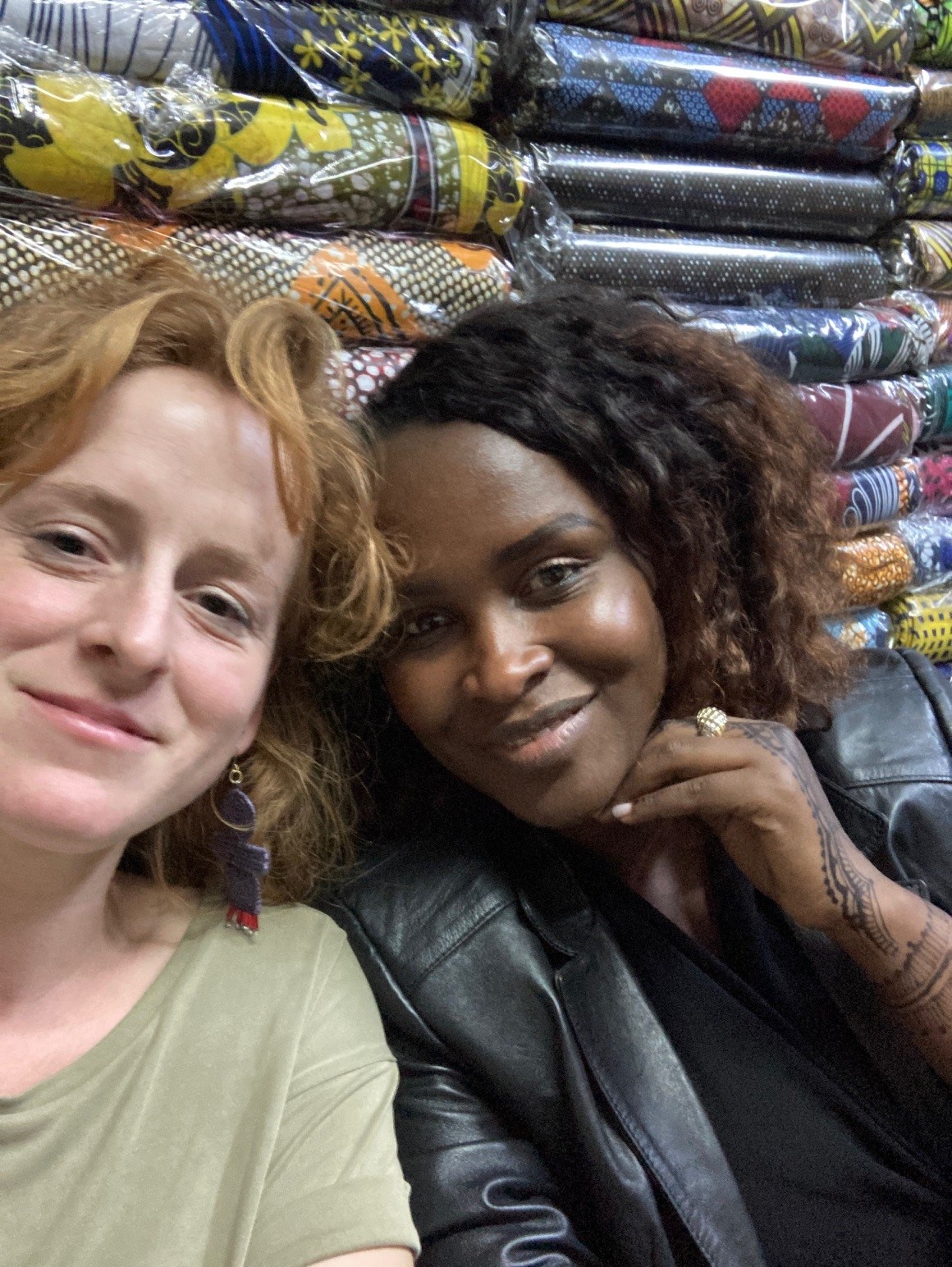
Liesbeth: I find it a difficult question to define sharply. In practice, with Joselyne from Rwanda Clothing, it was mainly a very organic story. Joselyne has become a close friend over ten years, and also requires a very specific approach. It is not so much a classic business as an enterprise of a passionate woman who does not let herself be dictated how it should be. My role is mainly: to accompany, listen, be present, pick up signals… but not to impose anything. I describe it more as co-creation than as imposing expertise.
We have been working together for several years now, and the contact is also rather personal; I regularly let Joselyne know that she can still count on help or expertise through Exchange, as soon as she is ready for it herself. My task as a coach is mainly to sense when she is ready for the next step, and in which domain.
I am also consciously a coach for only one company. When I was initially asked to also become a coach for Kibébé in Malawi, I passed that on to Nathalie Aerts, because with the many lives I already lead, I cannot take on another coaching trajectory. As an expert, I would very much like to continue working in Africa, because sharing my training and knowledge is, for me at this moment, the most meaningful thing I can do.
Do you have much contact with the African entrepreneur?
Liesbeth: We do not have weekly or fixed contact, but we do have a close, personal bond. I consciously compare my approach with that of other entrepreneur/coach duos who do call weekly and systematically work through agenda items. That would not work for me. There are significant differences between coaches in how they approach this, and that is precisely the charm of the model: each coach senses what the programme or the entrepreneur needs and deals with it in a natural way.
Have you travelled to Africa often for Exchange?
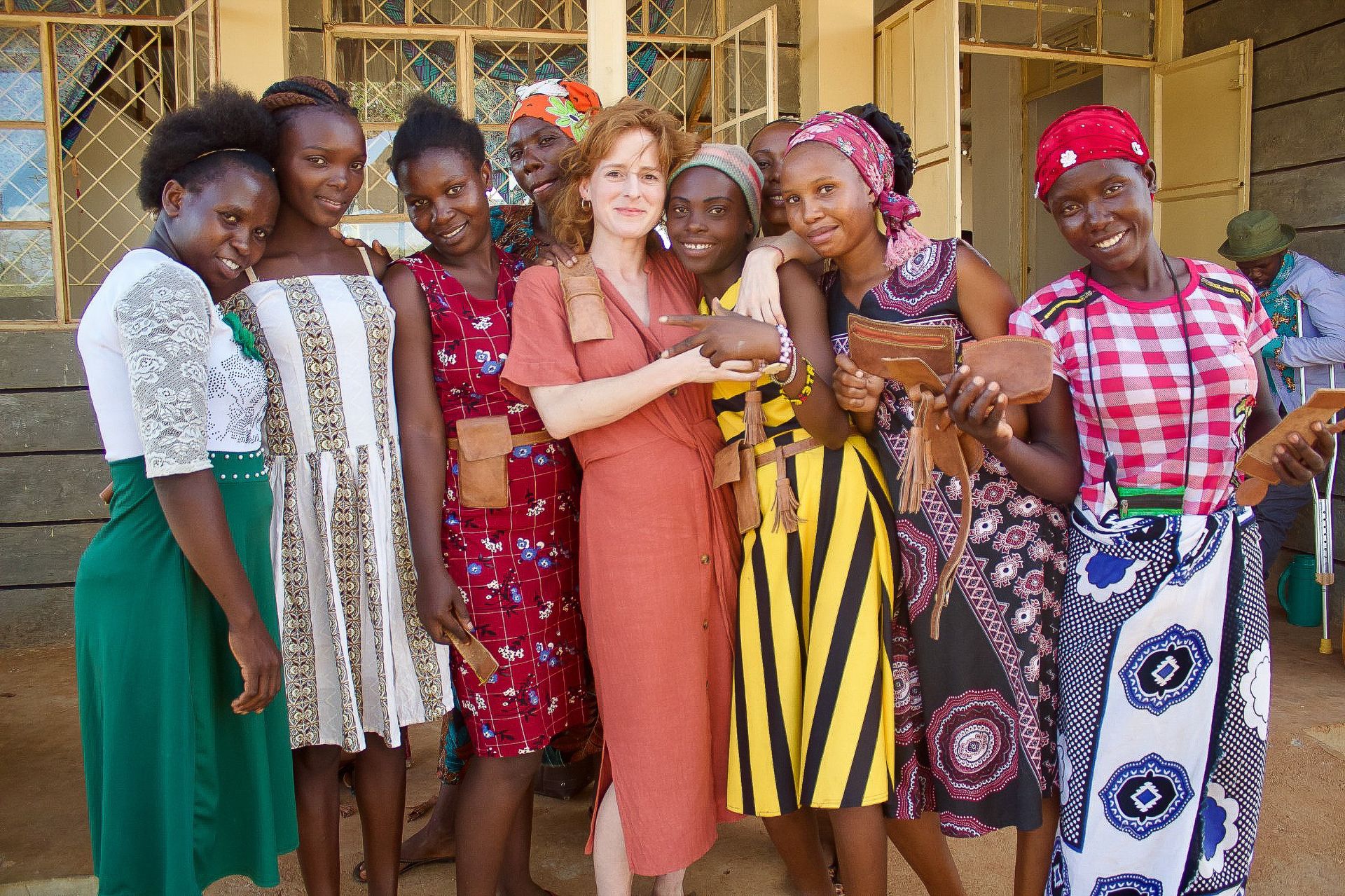
Liesbeth: Over the years, I have travelled to Rwanda as an expert three times to give training sessions, each time at a higher level. Once, I also went together with Gaston (Business Development Manager Rwanda) to map the needs of all the fashion designers in Kigali. Since I became a coach, I have been somewhat less bound to official missions. For instance, during the Christmas holiday, I visited Rwanda with my partner - we were looking for winter sun, and a week in Rwanda turned out to be cheaper than a European destination. Although that visit was not officially for Exchange, I still had the usual conversations with Joselyne about Exchange and Rwanda Clothing.
Do entrepreneurs come with specific questions or do you find out for yourself what the entrepreneur needs?
Liesbeth: In the case of Joselyne and Rwanda Clothing, the question comes one hundred percent from her. I never want to push. I pick up subtle signals about where her interest lies at a certain moment, for example when she wanted to expand her furniture and interior department and later when that interest shifted somewhat to the background and the focus moved more towards clothing production or handbags, and I try to respond to that carefully, without forcing it.
Rwanda Clothing & Rwanda
Can you tell us about Rwanda Clothing and your commitment to the company?
Liesbeth: I have been following Rwanda Clothing for about ten years now. I started as a leather processing expert and after an initial training, I also did a joint training on pattern improvement together with Exchange coach and expert Nathalie Aerts. In doing so, we taught the team a different way of working: first developing patterns on paper instead of drawing directly on fabric, so that adjustments can be made on paper and not on a finished garment. For example, we solved a recurring pattern error in trousers.
What kind of missions have you carried out?
Liesbeth: In addition to previous missions in Senegal, I went to Rwanda, where I conducted the training alone and together with Nathalie Aerts as I described above. About three years ago, I also went to Malawi for Kibébé. That mission focused on diversifying the product range, which was then heavily tourism-oriented. I introduced the idea of menstrual underwear and pads there. Kibébé works with refugees from a nearby refugee camp, where many basic needs, including menstrual products, are hard to find. That avenue was also effectively pursued, and after the mission, two large orders followed. During that mission, I also made product improvements for other Kibébé products.
Have you seen any concrete changes in Rwanda Clothing as a result of your role as a volunteer coach?
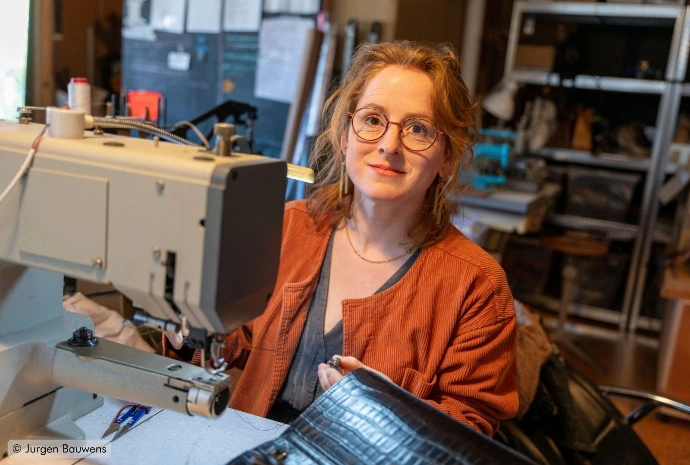
Liesbeth: Yes, and I find that incredibly fascinating myself. During my first visit to Rwanda Clothing, there was not a single physical paper pattern; in the meantime, there is a wall full of toiles (the calico versions of Joselyne’s collections). The first handbags we made together were at a beginner level, but with each subsequent visit, I saw that the products became more technical, labour-intensive, and of higher quality, with fewer pattern and construction mistakes.
Have you also learned things from your engagement? Do you take things home with you after such a mission?
Liesbeth: Certainly. I have become a much richer person because of it. I also incorporate the stories into my own lessons in Belgium. For example, that you don’t need the most expensive or all the tools to get something done, and that there is always a way to work around the lack of materials or resources. I think of someone who threw sand on a stone to sharpen knives - a manual, no-nonsense way of working that I find fascinating and that differs greatly from how things are approached in Belgium.
I am also struck by the different way companies scale there: someone can simply hire two skilled workers immediately and grow that way, whereas in Belgium you tend to do everything yourself first before hiring staff. I find that incredibly interesting, but also very confronting: I am seen as an expert on the ground and contribute skills, while in Belgium it is a huge cost to hire even one person.
How do you view entrepreneurship in Rwanda?
Liesbeth: I notice that working conditions have improved significantly in recent years. Previously, people worked from seven in the morning until seven in the evening without many contracts or rules. In the meantime, there are new contracts, the 9-5 workday is the norm, and wages have increased. What also fascinates me is the social savings system within many companies: every month, everyone contributes a small amount to a common pot, which then goes in turn to one employee to fund, for example, a large purchase, a funeral, or a celebration. A separate, strong social structure within the company itself, perhaps also because an extensive safety net like that in Belgium does not yet exist there.
As far as Joselyne's entrepreneurship is concerned: Rwanda Clothing is a true family business, where she takes on the responsibility of providing work for everyone in the family. Such a thing plays less of a role in the more individualistic context that we know here. Joselyne, in turn, finds the way we Belgians deal less closely with our family quite sad.
Do you have a good relationship with Joselyne?
Liesbeth: Yes, immensely. Joselyne has grown into a dear friend over the ten years I have known her, and we know each other's personal lives inside out. Our collaboration is very organic, based on who we both are, with a lot of attention to each other's personal stories. Joselyne is currently mainly a mother of two young children, after a difficult divorce, and has been struggling with burnout for the past two to three years, which has made her less present in her own company. In the meantime, Rwanda Clothing can fortunately continue to operate successfully without her constant presence.
What impressions has Africa already left on you?
Liesbeth: Rwanda feels to me like a metropolis: easy to travel to, aimed at relatively wealthy tourists, and a place where I feel completely left alone as a woman travelling alone. This contrasts sharply with my experience in Senegal, where a woman travelling alone is quickly associated with looking for a man. And also with Malawi, where I sometimes feel like a wealthy tourist who is constantly being asked for help.
I notice that I see each country mainly through the eyes of the people I am working for at that moment: in Rwanda, I move within Joselyne's higher social class, in Malawi I looked through the eyes of refugees in the camp where Kibébé is active. Those personal connections continue to play a role when I am back home: I think, for example, of a friend in Kenya who has to fight every day to make ends meet, and I am regularly contacted via WhatsApp by people I have met in various countries, with specific requests for help. I find it difficult to deal with this: as a perfectionist, I constantly feel that I am not doing enough, and sometimes I feel like I am 'falling short as a human'. That feeling is less strong in my role towards companies, as that relationship is more structured.
Volunteering
Why are you a volunteer?
Liesbeth: On a selfish level, volunteering allows me to see a part of the world in a way that feels safe to me. I recognise unspoken requests for help everywhere and want to help people to elevate their products a step higher. Additionally, I feel very privileged to have been able to enjoy so much education and training, something that is far from a given in other parts of the world. I want to offer people equal opportunities by sharing a piece of that privilege with them. Sharing is multiplying. I also often think of a quote from Solid Crafts that has stuck with me: ‘Let’s rise by lifting others.’
For me, following that path feels almost like a survival mechanism. I do not expect others to do the same as I do, but for myself, it is really necessary to live meaningfully. I call it a primal instinct that I do not reflect on or doubt, even in a world that is today strongly divided and polarized: I do not rely on higher authorities to solve problems, but prefer to take matters into my own hands. I have that attitude as an entrepreneur as well, although I realize that sometimes I want to do everything myself too much.
What do you think is the greatest benefit of your role as a volunteer?
Liesbeth: I strongly link this to my future plans: I once promised myself that by the age of forty, I wanted to be ‘an institution’ in fashion, and that has succeeded. My next dream, towards my eighties, is to start a school around leatherworking in an African country, to create more equality of opportunity. I describe myself as a doer and try to focus mainly on what I can concretely do to make humanity a little more humane.
And from Exchange? What do you think is our strength?
Liesbeth: I particularly appreciate your evolution towards a multi-year plan: less optional, more embedded, with more expectations. In my opinion, this leads to a much higher chance of success than one-off missions without further follow-up. To this day, I do not know what happened to the people I trained during my first mission in Senegal. In contrast, with Rwanda Clothing, which I have been following for ten years now, I see the results very concretely: the company has grown enormously. Also, with Kibébé in Malawi, actions lead to visible results much faster. I find the current model much more tangible, and I think that improvement resonates in many areas.
Are there also weaknesses in our model?
Liesbeth: I sometimes ask myself whether it has not become a bit obvious for entrepreneurs in the South to rely on volunteer work. For example, I notice that Rwanda Clothing can draw from a wide range of different types of expertise and support - something that I, as a Belgian entrepreneur, am sometimes quite envious of, because I do not easily find that level of support for my own business. At the same time, I immediately nuance that: I cannot strongly substantiate this feeling, given my limited comparative experience, and it partly stems from my very specific, organic bond with Joselyne. With another duo of entrepreneur and coach, the collaboration might proceed very differently. Although I think that what seems like a weakness at first glance - the fact that everyone approaches it in their own way - is also a strength: it makes each programme and each story unique, just as the people themselves are all unique.
What is, for you, the essence of being a volunteer?
Liesbeth: I revert to my favourite slogan: ‘Sharing is multiplying.’ That is also what the workshop leader said to me during a debriefing on one of my missions: that I give without a hidden agenda, without holding back on my giving, because I simply want to share all my knowledge. For me, that is precisely the essence of volunteering and only then does being human feel truly meaningful to me: when I can help others make life a little easier.